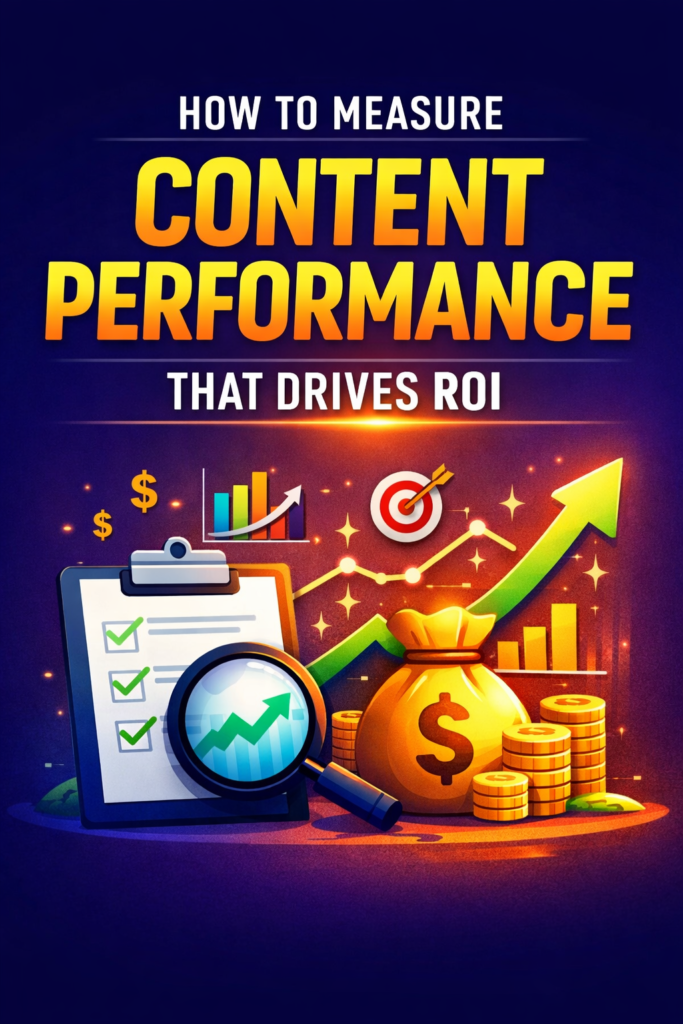
In today’s digital world, understanding how to measure content performance is not optional — it’s essential. If you create blogs, landing pages, videos, emails, or social posts, you need clear proof that your content is driving traffic, engagement, leads, and revenue.
This guide explains the most searched and practical methods marketers use to track results, analyze content metrics, and improve ROI — without confusion or fluff.
Table of Contents
How Do You Measure Content Performance?
You measure content performance by tracking specific metrics that align with your business goals. The key is not to track everything — only what directly supports growth.
Here’s a simple 4-step framework:
1. Define Your Goal
Ask: What is this content supposed to do?
- Increase website traffic
- Generate qualified leads
- Improve brand awareness
- Boost conversions
- Reduce customer acquisition cost
Each goal requires different KPIs.
2. Choose the Right Metrics
Common performance indicators include:
- Organic traffic
- Click-through rate (CTR)
- Time on page
- Bounce rate
- Conversion rate
- Lead generation numbers
- Revenue attribution
- Engagement rate (comments, shares)
For example:
- Blog posts → Traffic + engagement metrics
- Landing pages → Conversion rate
- Email campaigns → Open rate + CTR
3. Use Analytics Tools
Popular tools include:
- Google Analytics
- Google Search Console
- Heatmap software
- CRM dashboards
- Marketing automation platforms
These tools help you track user behavior, audience retention, and funnel performance.
4. Analyze & Optimize
Data without action is useless.
Ask:
- Which content drives conversions?
- Which traffic sources convert best?
- Which topics get backlinks?
- Where do users drop off?
Then improve headlines, CTAs, internal linking, or content depth accordingly.

What Are KPI in Content Strategy?
KPIs (Key Performance Indicators) are measurable values that show whether your content strategy is working.
They fall into 4 major categories:
1. Traffic KPIs
- Organic sessions
- Page views
- New vs returning visitors
2. Engagement KPIs
- Average session duration
- Scroll depth
- Social shares
- Comments
3. SEO KPIs
- Keyword rankings
- Backlinks earned
- Domain authority
- Impressions
You can learn deeper SEO insights from trusted resources like <a href=”https://moz.com/beginners-guide-to-seo” target=”_blank” rel=”dofollow”>Moz’s SEO Guide</a>.
4. Conversion KPIs
- Lead submissions
- Sales
- Cost per acquisition
- Revenue per visitor
Strong content strategy connects these KPIs to business objectives — not vanity metrics.
How to Measure Content Effectiveness?
Content effectiveness is about impact — not popularity.
A post with 10,000 views but zero leads is not effective.
Here’s how to evaluate real effectiveness:
✔ Measure Against Intent
Does the content match search intent?
- Informational
- Commercial
- Transactional
If intent alignment is wrong, performance drops.
✔ Compare Against Benchmarks
Check:
- Industry averages
- Past performance
- Competitor standards
✔ Check Assisted Conversions
Sometimes content doesn’t convert immediately but assists later sales. Multi-touch attribution models help track this.
✔ Measure Content Depth Signals
- Scroll tracking
- Returning visitors
- Email subscriptions
Effective content builds trust and long-term engagement.
How Do You Know If Your Content Is Performing Well?
Your content is performing well if it:
- Ranks for target keywords
- Generates consistent organic traffic
- Builds backlinks naturally
- Drives conversions
- Reduces paid advertising dependency
A healthy content asset usually shows:
- Growing impressions
- Stable or increasing CTR
- Improved average engagement time
- Declining bounce rate
For example, if you publish an article on platforms like mydearquotes com, you can analyze referral traffic and user engagement from that source to measure impact.
Strong performance also shows in audience behavior:
- More brand searches
- Higher direct traffic
- Increased newsletter signups
What Is the 70/20/10 Rule in Marketing?
The 70/20/10 rule helps balance content investment:
- 70% Core performing content (proven topics)
- 20% Optimization and updates
- 10% Experimentation and innovation
When measuring performance, analyze which bucket your best-performing content belongs to.
Often, updated content (the 20%) drives faster ROI than creating something new.
What Is the 3-3-3 Rule in Marketing?
The 3-3-3 rule focuses on:
- 3 audience pain points
- 3 core content pillars
- 3 measurable outcomes
It simplifies content planning and performance tracking.
For example:
Pain Points:
- Traffic problems
- Low conversions
- Poor engagement
Content Pillars:
- SEO education
- Funnel strategy
- Conversion optimization
Outcomes:
- More traffic
- More leads
- Better ROI
This structured system makes performance tracking clearer.
What Is the 50/30/20 Content Strategy?
This strategy focuses on content mix:
- 50% Educational value
- 30% Brand authority
- 20% Promotional content
When measuring performance, compare which category converts better.
Educational content often brings traffic.
Authority content builds trust.
Promotional content drives revenue.
Balanced strategy improves long-term results.
Advanced Content Performance Tracking
Now let’s move deeper into advanced measurement strategies.
Attribution Modeling
Not all conversions happen instantly.
Types of attribution models:
- First-touch attribution
- Last-touch attribution
- Linear attribution
- Time-decay attribution
SaaS companies especially benefit from multi-touch tracking to understand long buying cycles.
Content Scoring System
Create a numeric scoring system:
Example:
- Traffic (25 points)
- Engagement (25 points)
- SEO value (25 points)
- Conversions (25 points)
Total: 100 points
This helps compare content assets objectively.
Measuring ROI
Simple ROI formula:
ROI = (Revenue from content – Cost of content) ÷ Cost of content
Include:
- Writer cost
- Design
- Promotion
- Tools
Many brands improve ROI by publishing through trusted platforms using SEO guest post strategies to gain backlinks and referral traffic.
FAQs
how to measure content performance
Start by defining your business objective. Then track traffic metrics, engagement signals, conversion data, and revenue attribution. Use analytics dashboards and compare performance monthly. Look beyond page views — focus on outcomes like leads, customer lifetime value, and assisted conversions.
how to measure content marketing performance
Measure overall content marketing performance by combining SEO metrics, funnel analytics, CRM data, and revenue tracking. Evaluate organic growth, brand search volume, cost per lead, and sales influenced by content. Use attribution models to see content’s role in the buyer journey.
how to create measurement frameworks for saas content performance
For SaaS:
Map content to funnel stages (TOFU, MOFU, BOFU).
Assign stage-specific KPIs.
TOFU → Traffic + engagement
MOFU → Lead magnets + demo requests
BOFU → Trial signups + conversions
Use cohort analysis and customer acquisition cost tracking.
Measure churn reduction influenced by educational content.
SaaS measurement frameworks must include subscription revenue and retention metrics.
how to measure content performance in ai search
AI search (like AI-generated summaries) requires new tracking methods:
Monitor impressions in search console
Track brand mentions
Measure zero-click visibility
Analyze structured data performance
Watch branded search growth
Focus on topical authority and semantic coverage instead of just keyword ranking.
how to measure content performance of testimonials
Testimonials should be measured by:
Conversion lift testing (A/B testing pages with vs without testimonials)
Click-through rate improvement
Time on page increase
Reduced bounce rate
Assisted conversion tracking
Use heatmaps to see if users interact with testimonial sections.
Final Thoughts
Measuring content performance is not about collecting random numbers. It’s about aligning metrics with business growth.
Track:
- Traffic quality
- Engagement depth
- Search visibility
- Conversion performance
- Revenue impact
Then optimize continuously.
The brands that win are not those who publish the most content — but those who measure, refine, and scale what truly works.